
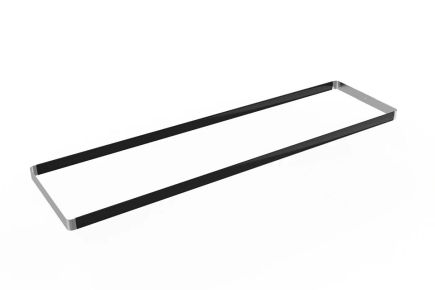
Steel Belt
High-strength stainless steel belts for securing and bundling battery cells inside modules, providing mechanical support against vibration, impact, and thermal expansion.
In battery modules, steel belts are mainly used to fix and strap battery cells so they remain stable inside the module. The belt tightly binds cell units and provides the mechanical support needed to prevent shifting or damage during transport, installation, and use caused by vibration, impact, or thermal expansion.
This fixing method improves overall structural strength and ensures even force distribution between cells, improving module safety and reliability.
Specifications
Material: commonly 201 / 304 stainless steel

Size example: 668.4 脳 174.2 脳 19 mm (multiple sizes; customizable by cell model)
Appearance: stainless steel with heat-shrink tubing; tubing thickness 1 mm or 0.8 mm; 鈮? mm for 10 kV; 鈮? mm for 35 kV (typically 15鈥?0 kV)
Process
High-strength low-alloy or stainless steel strip is cut to size, fitted with heat-shrink tubing, processed in a tunnel furnace, then punched, bent, and welded. After dimensional and quality inspection, products are packed for shipment.
Advantages
- High strength: withstands high tension and pressure with long service life
- Corrosion resistance: resists moisture, acids/alkalis, and salt spray
- High-temperature resistance: maintains strength and stability under heat
- Flexible customization: thickness (e.g. 0.8 / 1 mm) and dimensions to fit the module
- Easy installation and maintenance
- Recyclable and environmentally friendly stainless steel
Applications
- Electric vehicles: strap cells for stability under vibration and temperature swings
- Energy storage systems: long-term reliability in harsh environments
- Consumer electronics: compact, high-density module support
Quality
- Dimensional accuracy: length typically 卤0.5 mm; thickness typically 卤0.2 mm (per customer drawing)
- Mechanical tests: tensile strength generally 鈮?300 MPa; overall tensile force typically ~25 kN
- High-temperature/humidity: GB/T 2423.50-2012, 85掳C / 85% RH, 1200 h 鈥?tubing without aging cracks, brittleness, or loosening
- Heat-shrink tubing: flame retardancy per GB/T 2408; REACH / RoHS compliant