
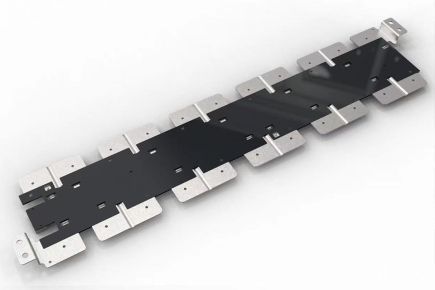
Integrated Busbar
Integrated busbars interconnect cell terminals so current flows efficiently across the module, with mechanical strength and optional thermal benefits.
Integrated busbars play a central electrical interconnection role in battery modules. They connect cell terminals so current transfers efficiently between cells and the module can charge and discharge normally.
Design must balance conductivity with enough mechanical strength to support module stability and prevent fracture from vibration or impact. Busbars can also contribute to heat spreading to help maintain a suitable operating temperature.
Specifications
Materials: copper, aluminum, or copper alloys
Dimensions: customized to customer products and modules
Types: PCB rigid integrated busbars and FPC flexible integrated busbars; copper thickness per design
Applications: prismatic cell modules, energy-storage PACK, power batteries
Process
Typically made from high-conductivity copper, aluminum, or alloys. Plating or coating improves corrosion resistance and conductivity, extends life, lowers contact resistance, and keeps electrical performance efficient and stable.
Advantages
- High conductivity for efficient current collection and distribution
- Thermal spreading helps keep module temperature balanced
- Plated surfaces improve corrosion resistance
- Structural toughness for reliable mechanical support
- Lightweight designs (especially aluminum alloys) for EV weight reduction
Applications
- Module electrical interconnection
- CCS assemblies
- Energy storage PACK